

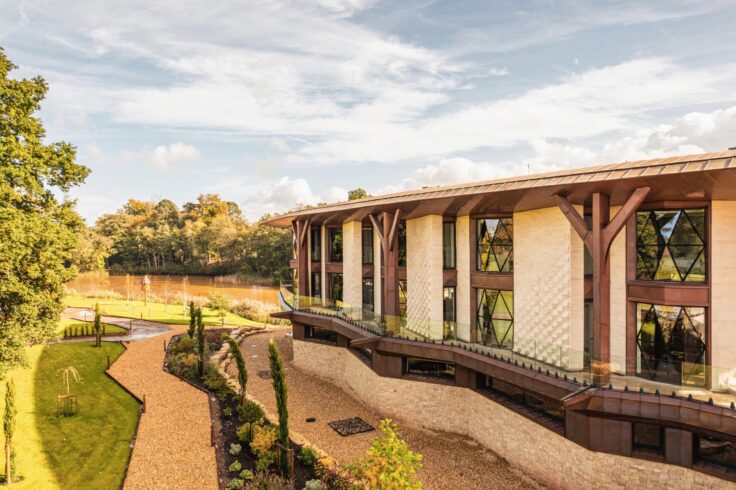
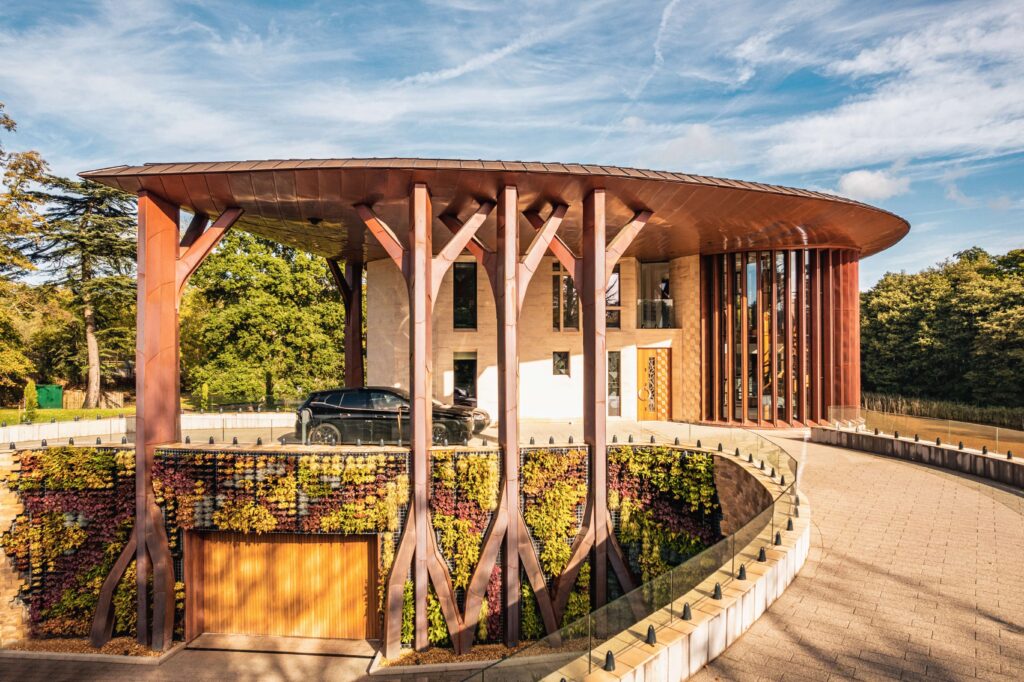
In today’s construction landscape, architects and specifiers face a dual challenge: meeting client ambitions while delivering on ever-tightening environmental targets. The choice of materials has never been more critical. At Blacknest Park in Ascot, a striking new lakeside residence designed by Oliver Steels of ERRAND Studio, the decision to build with natural stone from Stamford Stone Company demonstrates how sustainability and design excellence can coexist.
A House Shaped by Landscape and Material
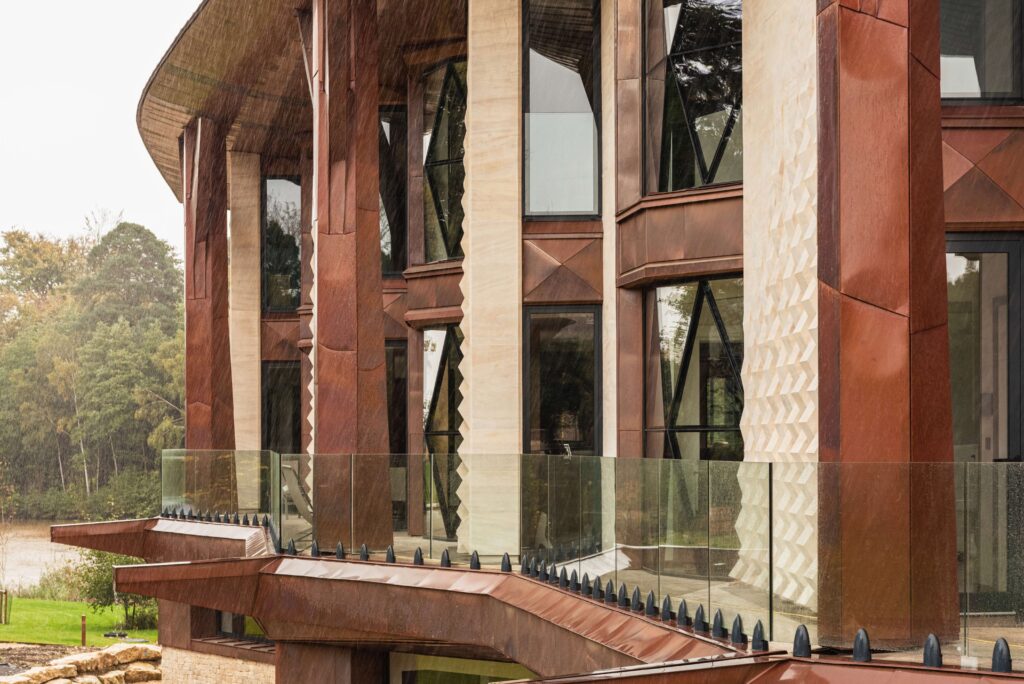
Blacknest Park is located in a sensitive setting: beside a lake, surrounded by protected woodland. The brief called for a design that would integrate rather than impose. Inspiration came from the distinctive “dog-tooth” stonework at Ripon College’s Bishop Edward King Chapel, but the architectural language here is undeniably contemporary.
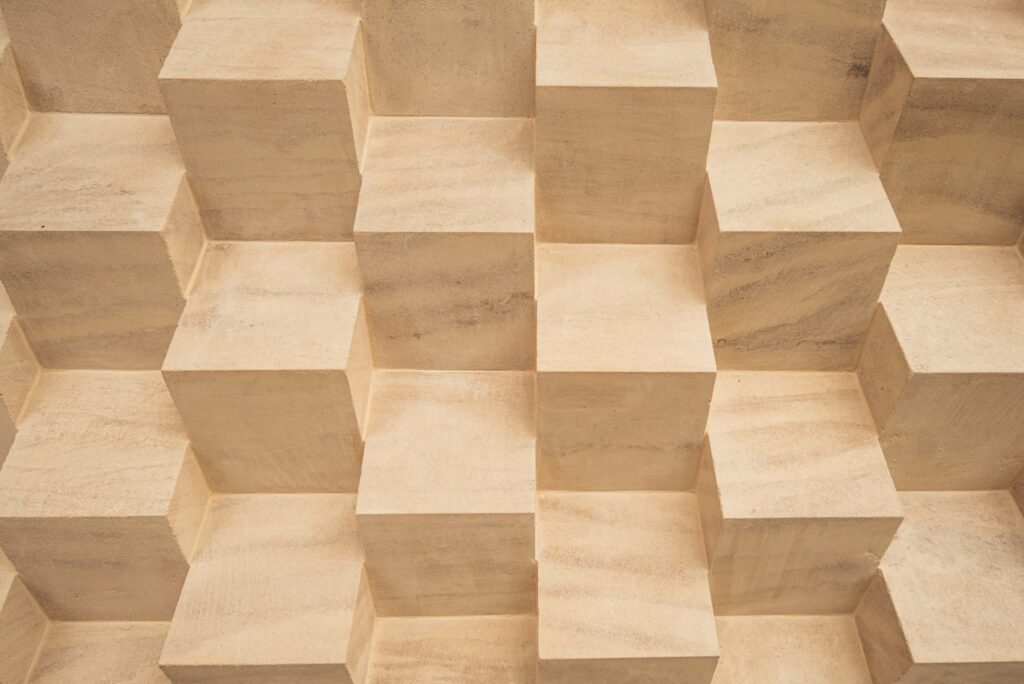
To realise this vision, Stamford Stone supplied around 250 m³ of Clipsham limestone, including 135 m³ of architectural masonry for external walling, heads, cills, and finial jambs. Advanced CNC cutting produced naturally coursed stonework, while internally, bespoke limestone flooring and tiles completed the scheme. The result is a home that feels rooted in its environment, with a material palette that enhances the building’s connection to place.
Sustainability Written in Stone
What makes this project stand out is not just its visual presence but its environmental credentials. Stamford Stone owns and operates the two Clipsham Limestone quarries on the Lincolnshire Oolitic belt, providing direct control over extraction, processing, and delivery. This short supply chain significantly reduces embodied carbon: over 95% of material travels less than 20 miles from quarry to processing plant.
Rainwater is harvested and recycled on site, and all by-products are reused—whether as aggregates, lime dust for agriculture, or other secondary applications. Once a quarry’s working life is complete, sites are restored and replanted to blend back into the rural landscape.
Dan Wilson, Director at Stamford Stone, reflects on the company’s ethos:
“It’s always a joy to be involved in a project that pushes the boundaries of design and creativity. Blacknest Park was truly one of a kind, resulting in unique design features. But it also embodies our sustainability mission—proving that natural stone can be both beautiful and environmentally responsible.”
Embodied Carbon and Life-Cycle Advantage
The environmental performance of natural stone has often been under-acknowledged, but recent data strengthens the case. Stamford Stone has completed a full Environmental Product Declaration (EPD) on its Clipsham limestone. The results are impressive: a total Global Warming Potential (GWP) of just 3.59E+01 (kg CO₂e/m²).
To put this into context, the embodied carbon of concrete cladding can be more than 30% higher per kilogram than natural stone, while aluminium and brick are significantly more carbon-intensive across their life cycles. Where concrete or engineered stone must be replaced or maintained within decades, Clipsham limestone has a service life measured in centuries.
Life-cycle assessment (LCA) reinforces this advantage. With minimal processing requirements, low transportation emissions, and long-term durability, natural stone consistently outperforms synthetic alternatives in cradle-to-grave evaluations. The high thermal mass of limestone also contributes to operational energy savings—reducing heating and cooling loads, which further improves the whole-life carbon profile of buildings.
Innovation Meets Tradition
The success of Blacknest Park lies in blending advanced manufacturing with time-honoured craftsmanship. A six-axis Marchetti CNC machine allowed ERRAND Studio’s intricate stone detailing to be realised with precision and minimal waste. Yet the finished building retains the tactile warmth and subtle variation only achievable with a natural material.
Architect Oliver Steels comments:
“From the outset, we wanted the house to feel integrated with its setting, not imposed on it. Natural stone gave us that authenticity—every piece is unique, yet together they form a coherent whole. Working with Stamford Stone meant we could push design boundaries while knowing the material was responsibly sourced and sustainably managed.”
A Building with a Legacy
Perhaps the greatest sustainability argument for natural stone is longevity. Buildings such as Blacknest Park are conceived not just for the present but for generations to come. Clipsham limestone weathers gracefully, requiring minimal maintenance, and its structural and aesthetic qualities remain intact for centuries.
For clients, this means reduced replacement costs and lower life-cycle carbon emissions. For architects, it offers confidence that their design vision will endure.
Lessons for Architects and Specifiers
Blacknest Park provides several take-aways for professionals seeking to align design ambition with sustainability goals:
Authenticity and Aesthetics – Natural stone delivers timeless character while complementing modern detailing.
Low Embodied Carbon – Verified through EPD, Clipsham limestone demonstrates significantly lower GWP than many alternative cladding materials.
Longevity and Life-Cycle Value – A durable material with centuries-long service life reduces whole-life environmental impact.
Supply Chain Transparency – Local quarrying, recycling, and responsible land restoration give specifiers confidence in provenance.
Precision and Efficiency – CNC processing enables complex design with minimal waste.
Conclusion
Blacknest Park is more than a striking lakeside home—it is a blueprint for sustainable architecture. By choosing natural stone, ERRAND Studio and Stamford Stone have demonstrated that environmental responsibility can enhance, not limit, design quality.
As embodied carbon becomes a central consideration in procurement decisions, the verified data on Clipsham limestone shows that natural stone should be at the forefront of sustainable specification. It is a material that unites durability, authenticity, and low environmental impact.
For architects and specifiers committed to shaping a built environment that endures both aesthetically and environmentally, Blacknest Park is a powerful case study in how natural stone truly stands the test of time.


